
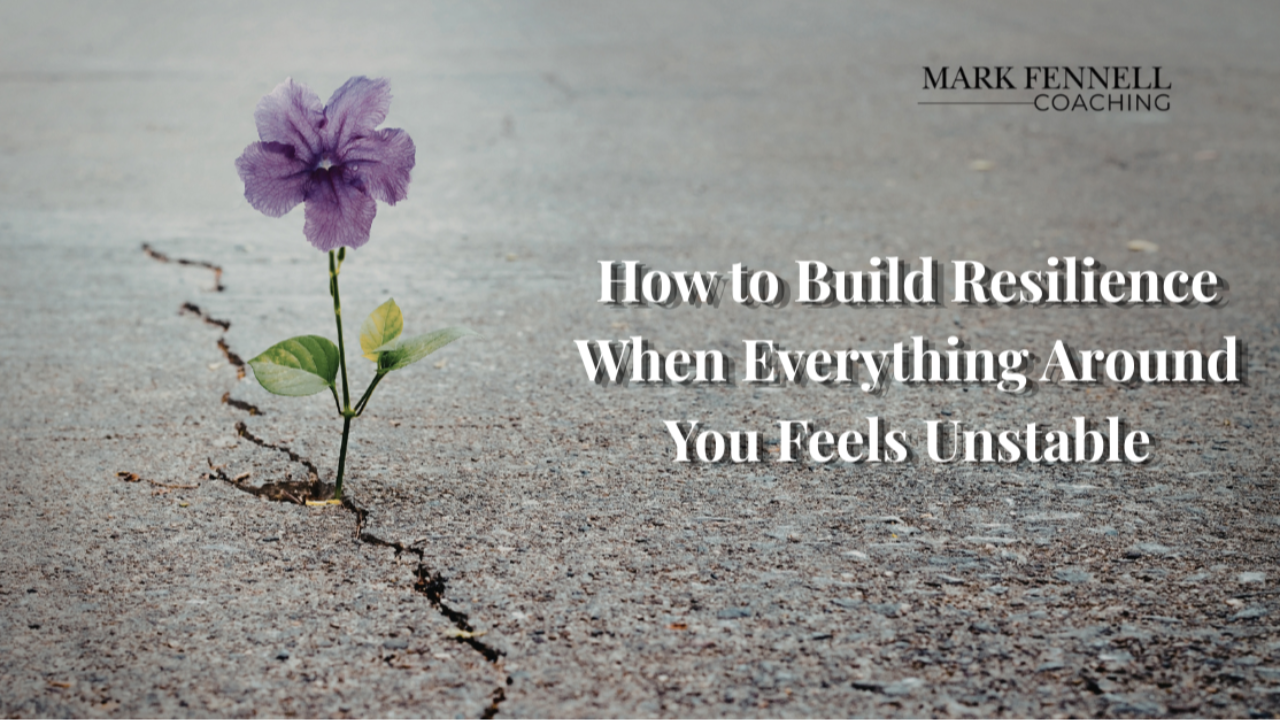
How to Build Resilience When Everything Around You Feels Unstable
There are periods in life where everything seems to be shifting at once.
Work is uncertain. A relationship is under strain. Your team is struggling. You are carrying more than you have capacity for and there is no obvious end point in sight. You are holding it together on the outside but on the inside, you are running on fumes.
If that sounds familiar, this post is for you.
Resilience gets talked about a lot. It is one of those words that appears in every leadership training, every self-help book, every corporate wellness email. And because it gets used so often, I think it has started to lose its meaning for a lot of people. They hear the word and picture someone who never breaks, never bends, never struggles. Someone almost inhuman in their ability to absorb difficulty.
That is not what resilience is. And that version of it, if you are chasing it, will exhaust you.
What I want to do in this post is give you a much more honest and practical picture of what building real resilience actually looks like, because in over twenty years of coaching people across Ireland, from business owners and executives to individuals going through some of the hardest chapters of their lives, I have seen what it genuinely takes.
And it is not what most people think.

What resilience actually is (and what it is not)
Let me start with what resilience is not.
It is not the absence of struggle. It is not pretending things are fine when they are not. It is not pushing through at all costs or never asking for help. In fact, in my experience, those behaviours are often the opposite of resilience. They are what burnout looks like in the early stages.
Real resilience is the ability to absorb difficulty without being permanently destabilised by it. It is being knocked, genuinely knocked, and still finding your footing again. It is not a fixed trait that some people have and others do not. It is a capacity that can be built, deliberately, over time, with the right approach.
And here is something important that I want you to hold onto as you read this post: resilience is not about becoming harder. The most resilient people I have ever worked with are not hard at all. They are clear. They know who they are, what they value, and where their limits are. That clarity is what carries them through.

Why building resilience matters more than ever right now
I work with a lot of business owners and leaders across Ireland, and the theme I keep hearing, regardless of industry or size of business, is the same: the pace of change and uncertainty has increased significantly. The challenges are not just professional. They are personal, relational, health-related, financial. They stack on top of each other and they do not wait politely for you to recover from one before the next one arrives.
In that kind of environment, resilience is not a nice-to-have. It is a practical necessity.
When your resilience is low, everything becomes harder. Decision-making suffers. Relationships become more fragile. Small problems feel enormous. You start reacting from a place of depletion rather than responding from a place of steadiness. And that has real consequences, for your work, your relationships, and your health.
When your resilience is strong, the same challenges are still there. They do not disappear. But your relationship to them changes. You have more capacity. More clarity. You can see further ahead. You recover faster. You make better calls under pressure.
That is the difference resilience makes in practice. And it is worth investing in.

The foundations of real resilience
There is no one-size-fits-all formula here, because people are different and circumstances vary. But in my coaching work, certain foundations come up again and again in the people who genuinely handle difficulty well. Here they are.
- Knowing your values and staying close to them
This one sounds almost too simple, but bear with me. One of the most disorienting things about a period of sustained difficulty is that it can make you lose your sense of who you are. You get pulled in multiple directions, you start making decisions reactively rather than intentionally, and slowly you drift away from the things that actually matter to you.
People with strong resilience tend to have a very clear sense of their values, what they stand for, what they will not compromise on, how they want to show up in the world. Not in a rigid way. But in a grounding way. When things get chaotic around them, those values act as an anchor.
If you have not done this work, I would encourage you to start small. Ask yourself: what are the two or three things that, if I abandoned them, would mean I had lost myself? Those are your anchors. Get clear on them. Come back to them regularly.
- Managing your nervous system, not just your diary
Most people approach resilience purely as a mental challenge. They think about it, plan it, set goals around it. But resilience is also deeply physical. Your nervous system is the hardware everything else runs on. And when it is chronically in a stress state, even the best mindset strategies will only get you so far.
What does nervous system management look like in practice? It is simpler than it sounds. It is sleep, taken seriously rather than sacrificed as a badge of honour. It is movement, not necessarily intense exercise, but regular physical activity that helps your body discharge stress. It is deliberate moments of stillness in a day full of stimulus. It is learning to recognise when your system is moving into overdrive and knowing how to bring it back.
I have worked with business owners in Ireland who were genuinely disciplined and talented people, but who were so chronically sleep-deprived and physically depleted that no amount of mindset coaching was going to land. We had to start with the physical foundations first. The mental clarity followed.
- Keeping perspective, especially in difficult moments
One of the things that erodes resilience fastest is catastrophising, turning a molehill into a mountain in thirty seconds. Our emotions are powerful and they are designed to protect us. But they are not always reliable narrators of reality, especially under stress.
The ability to step back and ask, "Is this as significant as it feels right now?" is genuinely one of the most valuable things you can develop. Not to minimise real problems. Real problems deserve real attention. But to stop your nervous system from treating every setback as a five-alarm emergency.
I often say to clients: never make a major decision while you are in the grip of a strong emotion, whether that is panic, frustration, or even excitement. Let the feeling settle first. Then assess. The problem usually looks different from a calmer vantage point.
- Building a support system you actually use
Nobody builds resilience alone. I cannot say this strongly enough. We are wired for connection. Our nervous systems regulate better in the presence of people we trust. The research on this is unambiguous: people with strong social and professional support networks recover from adversity faster, make better decisions under pressure, and experience less chronic stress.
And yet I constantly meet very capable, very accomplished people who are trying to navigate serious difficulties entirely alone. Sometimes it is pride. Sometimes it is the belief that needing support means they are failing. Sometimes they just have not built the relationships, because they were too busy being productive.
Do not wait until you are in crisis to build your support network. Build it now. That might mean investing in a close friendship. It might mean finding a peer group of people at a similar stage in business or life. It might mean working with a coach who can help you see your situation from a perspective you cannot access from inside it.
- Recovering properly, not just enduring
Here is something most people miss when they think about resilience: it is not just about how much you can take. It is about how well you recover. And recovery requires deliberate rest, proper disconnection, and the occasional permission to stop producing for a while.
In a culture that celebrates relentless hustle, rest gets positioned as weakness. It is not. It is the thing that makes sustained high performance possible. Physically, cognitively, emotionally, you cannot pour from an empty vessel. Recovery is not a luxury. It is a non-negotiable part of building the capacity to handle whatever comes next.
What resilience looks like when it is being tested
Let me be honest with you about something. Even with all of the above in place, there will be times when things are genuinely hard. When the difficulty is real and the capacity feels low and there is no quick fix in sight.
In those moments, resilience does not mean performing strength you do not feel. It means staying present. Asking for help. Taking one small step when you cannot see the whole path. Not making permanent decisions from a temporary low point.
I have been in those moments myself. I have had clients in those moments, people I respect enormously who have felt like they had nothing left. What I have seen, over and over again, is that the people who come through them best are not the ones who refused to admit they were struggling. They are the ones who stayed honest about it, reached out, and kept moving forward one small action at a time.
That is resilience. Not invincibility. Just the willingness to keep going, even when it is hard, and to get the right support to help you do that.

A final thought
If you are in a period right now where things feel unstable, where the ground keeps shifting and you are not quite sure how much more you can absorb, I want you to know this: the fact that you are still showing up, still reading, still looking for ways to handle it better, that is already resilience in action.
The capacity is in you. It just needs the right conditions to grow. And sometimes, those conditions include the right support.
[Image]
Want to build on this?
If difficult people, toxic dynamics, or the pressure of those around you are a big part of what is draining your resilience right now, my masterclass on dealing with narcissists and bullies is a great place to start. It covers the specific patterns that wear people down and how to handle them with far more confidence and clarity.
→ How to Deal with Narcissists & Bullies, Mark's Masterclass
Or if you would like to explore working together directly on your resilience, your leadership, or whatever challenge is front of mind right now, I am available for one-to-one coaching and executive coaching. Get in touch through my contact page and we can have a conversation about what is going on and what might help.
→ Work with Mark, Coaching & Contact
And for honest, practical content on resilience, leadership, and personal development delivered to your inbox every two weeks, you can sign up for my free newsletter at markfennell.ie. No noise, just the stuff that actually makes a difference.